
Direct mail as a supplier-funded channel: MDF, co-op, and trade promotion
What this study covers
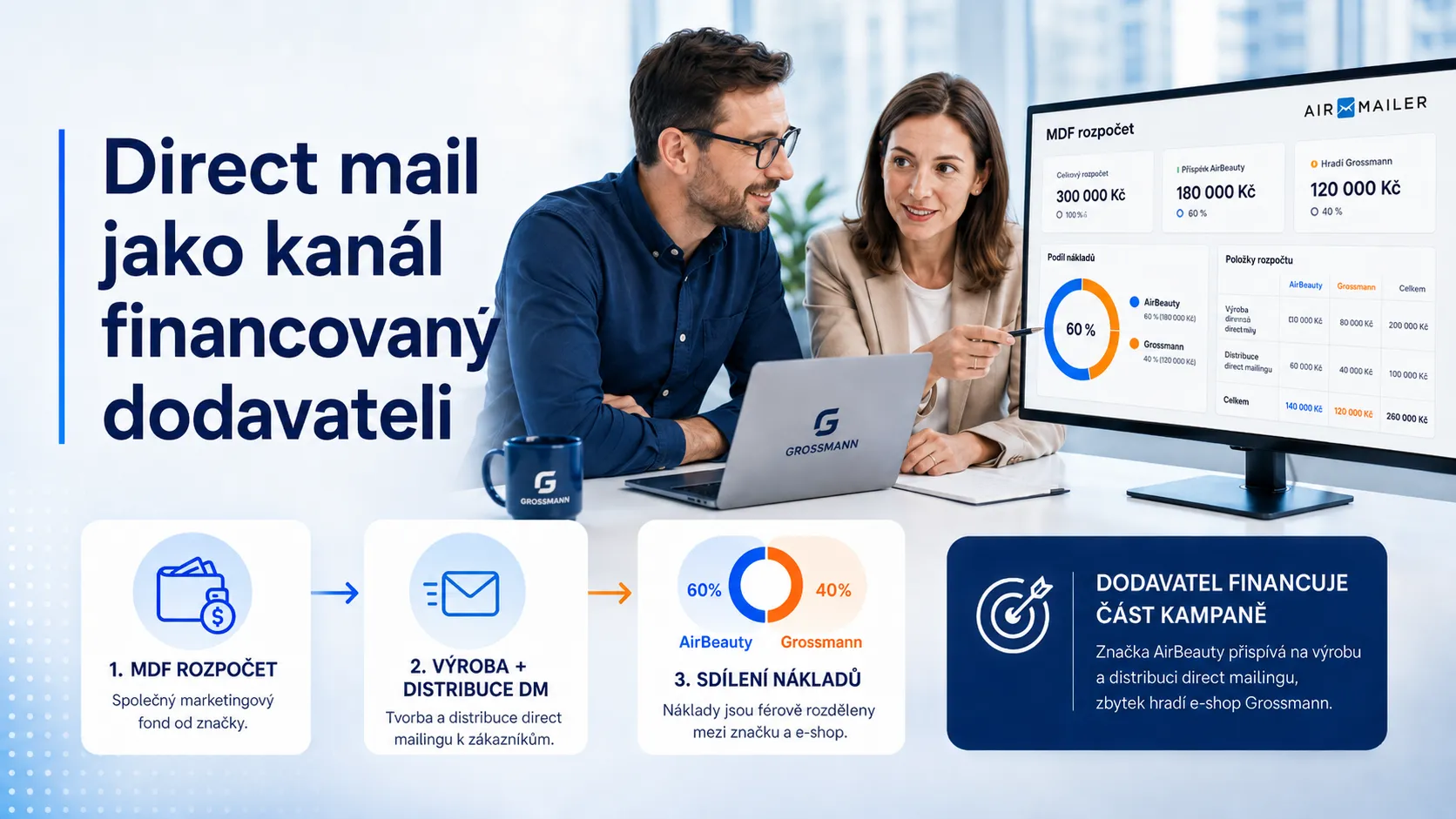
This study answers a specific budget question that direct mail has long handled badly in retail. The question is not whether the channel works — channel-level benchmarks are documented in other studies on airmailer.eu/cs/studie. The question is which budget pays for addressed mail to a retailer's loyalty file, who approves it, and how it compares to the supplier money that already funds printed flyers and prominent feature placement.
Key insights
In retail, a large share of marketing is not funded from a brand's CRM budget but from supplier money. Three overlapping budget sources — MDF (Market Development Funds), co-op, and trade promotion — are owned and approved on the brand side, and all three have funded the closest analogue to direct mail for decades: the retailer's printed flyer, prominent feature placement, listing fees, and in-store sampling. Addressed mail to a retailer's loyalty file sits in the same eligibility bracket. It is a more targeted, more measurable version of the printed medium that trade promotion has paid for all along.
The retailer's leverage is not theoretical. In the ANA 2024 study, 88 % of brands reported they feel "moderately or significantly pressured" by retailers to buy inventory on retailer-owned media. The framing is "have to buy," not "want to buy." A retailer that stands up an addressed direct-mail product line can pull the same lever that built digital retail media from zero.
The precedent exists publicly. Tesco and dunnhumby package addressed mail to the Clubcard file and sell it to FMCG suppliers as a retail-media product line.
Who approves what
The approval map across the three budget sources looks like this:
MDF is discretionary, brand-allocated, committed up front before the sale. The brand defines eligibility; the retailer or partner is reimbursed. Approved by the channel-marketing or shopper-marketing manager on the brand side.
Co-op is contractual, accrual-based, typically 1–5 % of partner revenue, cost-shared. Approved by the brand's sales lead and category lead, jointly with partner marketing.
Trade promotion covers manufacturer payments to the retailer for merchandising, listing fees, and feature placement in the printed flyer. Approved by the brand's sales lead and trade-marketing lead, negotiated with the retailer's category buyer.
The umbrella framework — the Joint Business Plan (JBP) with the brand — pulls retail media into the same conversation as trade and co-op planning, the conversation in which the flyer is decided. That is why the budget door for direct mail leads through the same hallway as the door for the flyer.
Why it is not free
Routing direct mail through a supplier fund is not the discovery of a new wallet. The ANA 2024 study shows that ~90 % of brand spend on retail media is not incremental — it is reallocated from existing budgets, from shopper marketing, brand marketing, trade, and the media ad budget. The supplier fund is zero-sum in aggregate; spend is reshuffled, not added. Direct mail will displace something in practice. Typical substitution candidates are declining printed flyers, underperforming on-site sponsored product placements, and in-store sampling — line items whose attention or measurable lift no longer matches the budget position they hold. Preparing the substitution argument before the JBP conversation is work the brand does up front, not during the approval round.
Why retail media networks do not show this yet
Today's retail media networks — Kroger Precision Marketing, Walmart Connect, Boots Media Group, and the IAB Europe channel map — describe their inventory almost entirely in digital terms: on-site, off-site, in-store digital, video, audio. Direct mail is eligible in that architecture, but understated. The explanation is not strategic; it is friction. The USPS OIG (US Postal Service Office of Inspector General) reports that in US marketer surveys, "lengthy and inflexible" mail preparation is the main reason marketers route around direct mail, even when its media logic holds. Friction is an entry barrier, not an argument against the channel — and it is the barrier automation removes.
Why it matters
For the retail media GM and the shopper-marketing lead on the retailer side, this is a high-leverage white space: a product line that already draws from supplier funds (the printed flyer) and that can be extended into an addressed version without inventing a new budget heading. For the channel-marketing manager and the sales and category leads on the brand side, it is an argument for the JBP conversation with a concrete substitution candidate attached. For the brand's CRM and lifecycle lead, it is how addressed mail moves from "new media spend" into "existing supplier line."
Practical relevance
This study is not a pitch, it is a budget map. Addressed direct mail as a retail-media extension inside the JBP runs against the standard media line (digital-first inventory) and requires a substitution argument tied to a concrete existing line item. For the brand, that means deciding the substitution before deciding the test. For the retailer, it means slotting an addressed direct-mail product line into the JBP conversation in the window when the printed flyer is decided. Airmailer covers only the part that removes the friction and where the supplier fund has value — automated production of CRM-driven addressed mail inside a retailer's or brand's lifecycle programme. The full research dossier, including per-source eligibility criteria and citations, is available on request.